.png)
Choosing between Quiqup and iMile is less about who can deliver parcels, and more about how your e-commerce operations are designed to run day to day.
Both companies operate in the UAE and serve e-commerce brands, including fast delivery use cases. But they are built around different operating assumptions. Brands that struggle after choosing usually don’t fail on price — they fail on cut-offs, handovers, returns, and workflow mismatches.
This comparison looks at Quiqup vs iMile through an e-commerce lens: delivery speed, fulfilment setup, integrations, COD handling, and where each partner fits best.
Quiqup and iMile Serve Different E-Commerce Models
At a high level, the distinction is structural.
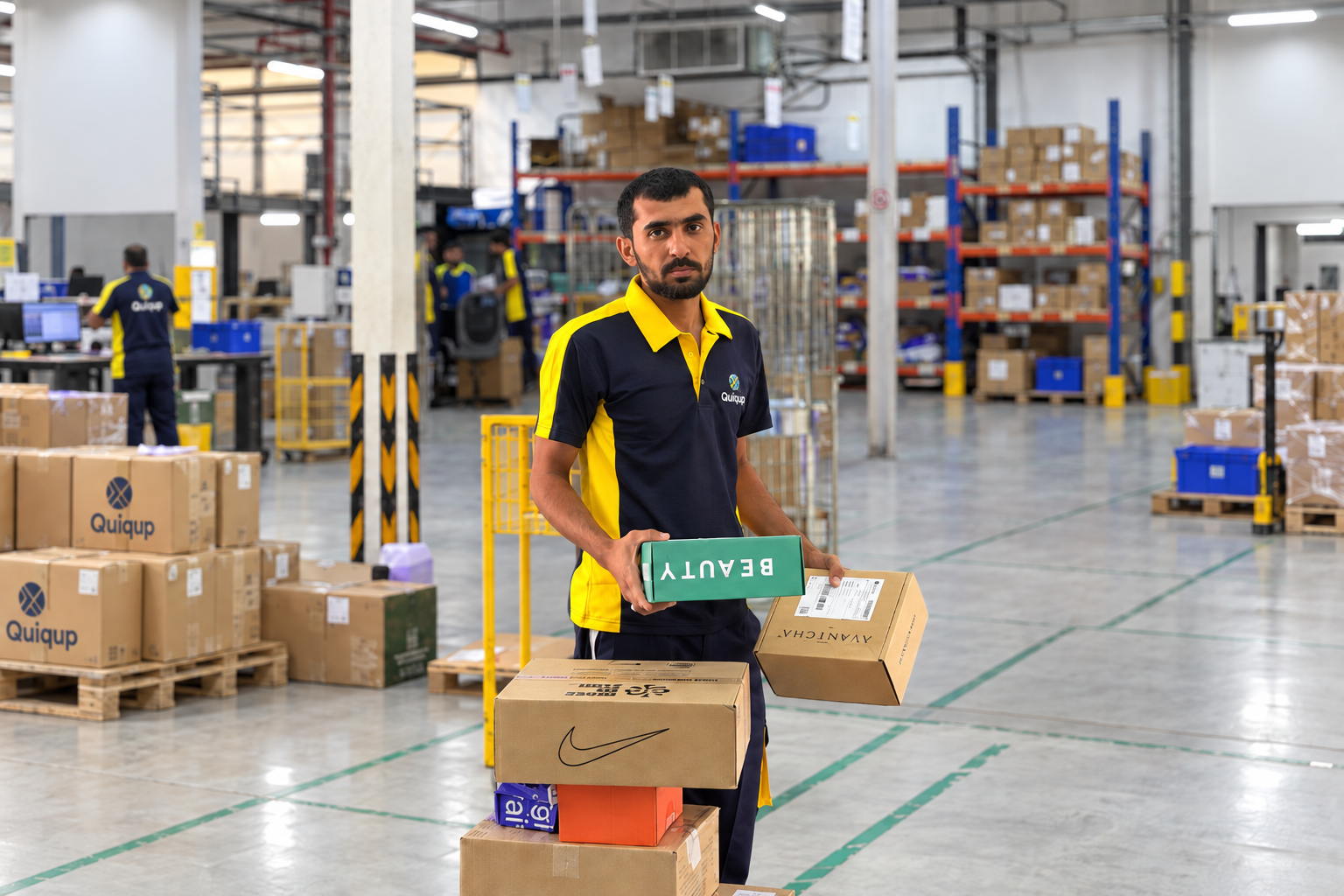
Quiqup is designed around integrated e-commerce fulfilment and last-mile delivery in the UAE, with fulfilment, dispatch, delivery, and returns designed to behave as one coordinated system.
iMile is built as a last-mile-first e-commerce logistics provider, offering fast delivery services and supporting fulfilment and warehousing as part of a broader logistics offering.
Both can support e-commerce. The difference is how tightly delivery is tied to fulfilment and how much operational coordination is expected from the merchant.
Delivery Speed and Same-Day Fulfilment
Quiqup: Speed Designed Into the System
Quiqup’s operating model is built around same-day and next-day delivery, supported by fulfilment workflows that are explicitly designed to hit tight cut-offs.
This works well when:
- delivery speed directly affects conversion
- orders arrive continuously throughout the day
- missed cut-offs lead to cancellations, refunds, or poor CX
Because fulfilment and delivery are coordinated closely, cut-offs, batching, and handover are managed as a single flow rather than separate steps.
iMile: Fast Delivery as a Core Offering
iMile strongly positions around fast delivery options, including same-day and next-day delivery within the UAE.
This fits businesses where:
- the primary requirement is last-mile speed
- fulfilment is already handled separately or is less complex
- delivery performance is evaluated mainly at the courier level
Speed is a strength, but fulfilment-to-delivery coordination may require more active management depending on setup.
Fulfilment and Warehousing Models
Quiqup Fulfilment
Quiqup offers e-commerce fulfilment in the UAE, including:
- storage
- pick and pack
- dispatch aligned to delivery cut-offs
- returns processing back to the same facility
This model is designed for daily order velocity, COD-heavy flows, and fast iteration. Fulfilment is not an add-on; it’s a core part of the delivery promise.
iMile Fulfilment Capabilities
iMile supports warehousing and fulfilment services as part of its e-commerce logistics offering, but the company’s centre of gravity remains last-mile delivery.
This can work well when:
- fulfilment volumes are predictable
- SKU complexity is limited
- speed of last-mile delivery matters more than fulfilment optimisation
For more complex fulfilment operations, additional coordination and process definition may be required.
Tech Stack and Platform Integrations
Quiqup
Quiqup integrates directly with common e-commerce platforms such as Shopify and WooCommerce, focusing on:
- automated order ingestion
- real-time fulfilment and delivery status
- reduced manual intervention for small and mid-sized teams
This suits lean D2C teams that want to minimise operational overhead.
iMile
iMile offers system integrations and technology tools to support e-commerce logistics and delivery tracking.
These integrations:
- support high delivery volumes
- are typically oriented around last-mile events
- may require more setup depending on fulfilment complexity
This works well for teams with in-house operational control or existing warehouse systems.
COD, Returns, and Customer Experience
Quiqup
Quiqup’s workflows are designed around COD-heavy UAE e-commerce, with:
- doorstep payment handling
- fast reattempt cycles
- quick return-to-warehouse flows
Faster delivery and returns help reduce refusal rates and shorten cash cycles.
iMile
iMile supports COD and returns at scale as part of its last-mile operations.
Return handling is typically structured around courier workflows, which works well for delivery-focused models but may require additional coordination if returns need to be processed rapidly back into stock.
Pricing and Commercial Structure (High-Level)
Direct price comparisons are rarely useful here.
- Quiqup’s commercial model reflects integrated fulfilment and delivery, speed, and operational coordination.
- iMile’s commercial model reflects last-mile delivery scale and efficiency, with fulfilment as an additional service layer.
The real cost difference often appears in:
- missed cut-offs
- failed deliveries
- return handling time
- internal operational load
Not just per-delivery rates.
When Quiqup Is the Better Fit
Quiqup is usually the better choice if:
- you run a D2C e-commerce brand
- fulfilment speed and delivery speed are tightly linked
- same-day or next-day delivery affects conversion
- you want fewer handovers between warehouse and courier
- your team prefers an integrated fulfilment + delivery setup
When iMile Is the Better Fit
iMile is often a good fit if:
- last-mile delivery speed is the primary requirement
- fulfilment is simple or already handled elsewhere
- volumes are high and predictable
- you want a delivery-focused partner with fast execution
Can Brands Use Both?
Yes.
Some brands:
- use Quiqup for fulfilment and core D2C delivery, and
- use iMile for specific delivery lanes or overflow capacity
This only works if order routing and inventory visibility are clearly defined.
Final Verdict: Quiqup vs iMile
This is not a question of who delivers faster in isolation.
It’s a question of operating model fit.
If your business wins on speed plus fulfilment discipline, Quiqup usually aligns better.
If your business needs fast last-mile execution with lighter fulfilment complexity, iMile can be a strong option.
The biggest risk isn’t choosing the wrong provider.
It’s choosing a provider whose model doesn’t match how your e-commerce operation actually runs.







.png)