.png)
From Shopify to the delivery van: how fulfilment tech stacks actually end up working in the UAE
For a lot of UAE e-commerce brands, fulfilment automation doesn’t start with a plan.
It starts with whatever works.
A Shopify store. A courier dashboard. A Google Sheet someone updates “just for now.” For a while, it’s fine. Orders go out. Tracking numbers exist. Customers mostly get their parcels.
Then volume grows. Same-day delivery becomes expected. Cross-border orders creep in. And suddenly the whole setup feels fragile.
Automation isn’t about adding more tools. It’s about removing the points where humans are making decisions they shouldn’t be making anymore.
What matters is the flow — from checkout to doorstep — and whether systems pass information cleanly enough that no one has to ask, “Did this go out?”
What most fulfilment setups in the UAE actually look like
Even when the tools differ, the shape is usually the same.
The storefront
Shopify, WooCommerce, Magento — this is where orders are born and expectations are set. Delivery options, payment method, address details. That’s it.
The storefront’s job is to capture intent, not decide how fulfilment happens. When delivery logic starts creeping into checkout hacks, things get brittle fast.
The decision layer
This is either an OMS, a WMS, or a combination of both. It’s where logic should live.
This is where orders get:
- validated
- assigned to a warehouse or fulfilment path
- blocked if stock isn’t really there
- routed based on delivery type or payment method
If people are deciding this manually inside courier portals or Slack messages, automation is already failing.
The warehouse / 3PL
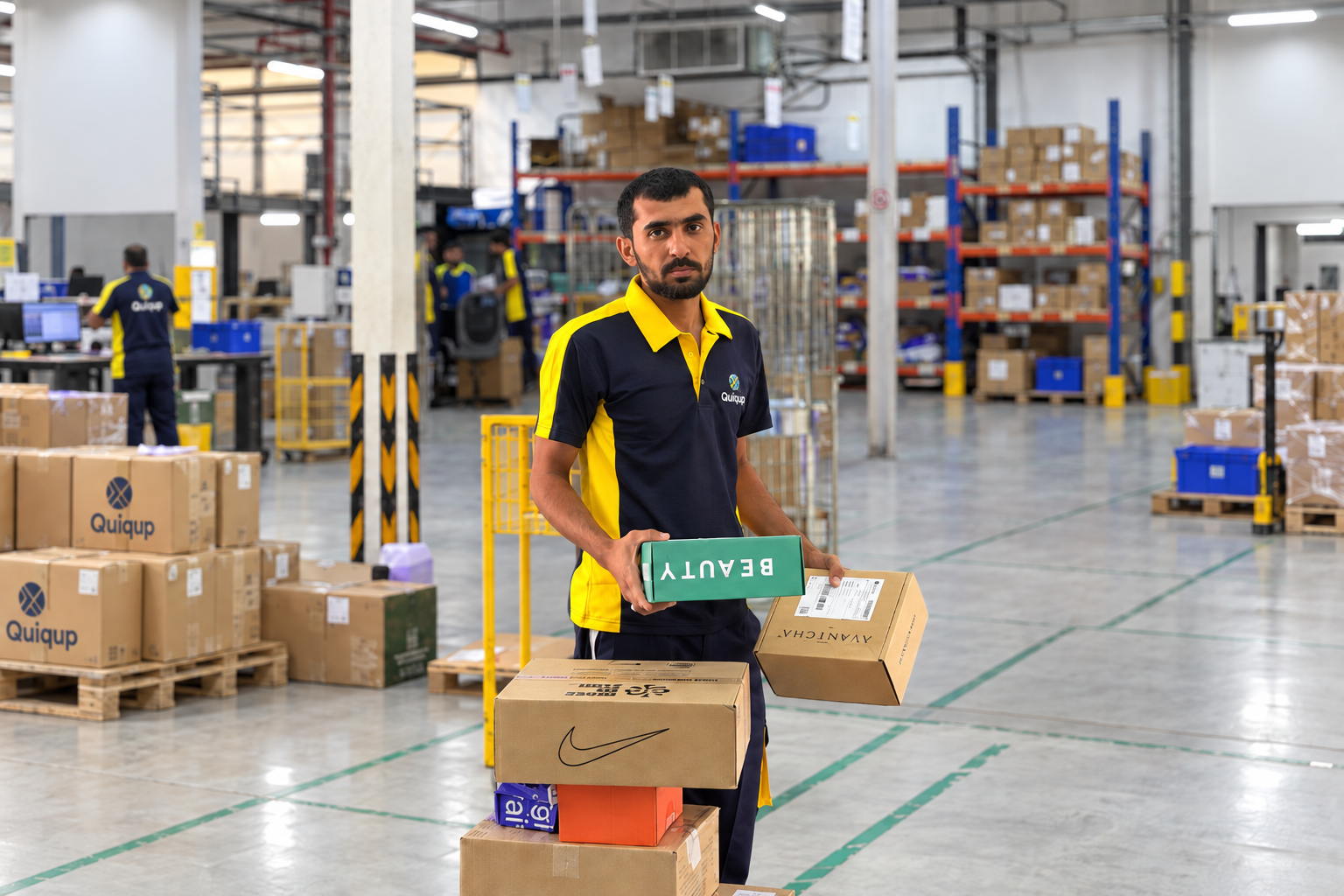
A good 3PL setup doesn’t make decisions. It executes.
Orders arrive already tagged with what needs to happen. Pick, pack, stage, hand over. No guesswork, no special emails, no “can you treat this one differently?”
When warehouses are improvising, the system upstream is broken.
The courier layer
Same-day, next-day, scheduled, cross-border. COD, BNPL, prepaid.
In mature setups, courier choice is rule-based. In fragile ones, someone is clicking buttons order by order.
Where automation actually pays for itself: routing logic
Routing rules are boring. They’re also where most cost savings hide.
In the UAE, this usually means rules like:
- orders before cut-off go same-day, after go next-day
- UAE addresses stay local, GCC goes cross-border, EU/UK go international
- COD orders use specific couriers
- BNPL orders only release after authorisation
- higher-risk orders get extra checks
These decisions should happen once, in one place. Not five times in five different dashboards.
If rules live inside courier portals instead of your own systems, you don’t really control fulfilment.
Why spreadsheets and CSVs fail quietly
Early on, manual processes don’t break loudly. They just slow things down.
Uploading CSVs. Copy-pasting tracking numbers. Updating order status at the end of the day. It all works — until it doesn’t.
Same-day delivery doesn’t tolerate delays. Neither do customers refreshing tracking links.
Real automation needs:
- webhooks that push orders instantly
- APIs that sync status changes and exceptions
- event-based updates, not nightly exports
If a system updates once per day, it’s already too slow for most UAE delivery promises.
How integrations usually go wrong
Most brittle setups fail for the same reasons:
- logic hard-coded into one tool
- one system acting as a single point of failure
- reporting tools used to make operational decisions
Healthier setups keep rules in one place, treat integrations as replaceable, and log failures — not just successes.
Automation should surface problems earlier, not hide them behind “everything synced” messages.
Where Quiqup fits, in reality
In a typical UAE stack, Quiqup sits between the warehouse and the last mile.
It helps with:
- structured handover from the warehouse
- access to different delivery services
- consistent tracking and status updates
- alignment with cut-offs and routing rules
It works best when it’s part of a flow that already makes decisions upstream. When it’s used as a manual override, it usually creates more work, not less.
Quiqup doesn’t decide what should ship or how. It executes delivery decisions your systems have already made.
What a calm, automated flow actually feels like
From the merchant’s side, it’s uneventful — which is the goal.
An order comes in.
It flows into the system.
Rules decide the path.
The warehouse executes.
Delivery happens.
Status updates just appear.
No spreadsheets. No copy-paste. No messages asking if something shipped.
When fulfilment feels calm, automation is doing its job.
The traps most teams fall into
A few patterns show up again and again:
- automating before fixing address and SKU data
- skipping a proper decision layer and routing straight from checkout
- assuming the 3PL or courier will “figure it out”
- adding tools instead of removing manual steps
Automation amplifies whatever structure you already have — good or bad.
Automating fulfilment in the UAE doesn’t require a complex stack. It requires clear separation of responsibility.
The storefront captures demand.
Your systems decide.
The 3PL executes.
The courier delivers.
When those roles blur, people fill the gaps. When they’re clear, systems take over.
If fulfilment feels fragile today, the answer is rarely more headcount.
It’s usually logic living in the wrong place — or missing entirely.







.png)