.png)
Top fulfillment companies in the UAE: which 3PLs actually fit e-commerce
For UAE e-commerce brands, fulfillment stopped being “backend” a long time ago.
It now shapes delivery speed, cash flow, returns, and customer trust — sometimes more than marketing does.
As volumes grow and expectations tighten, many merchants outgrow basic warehousing and start looking for fulfillment companies in the UAE that can handle inventory, pick and pack, returns, and courier coordination without breaking under pressure.
The problem is that not all 3PLs are built for e-commerce. Some are designed for pallets and predictability. Others are built around order velocity and cut-off times. Mixing those up is where frustration starts.
Below is a practical overview of the most relevant fulfillment and 3PL ecommerce providers in the UAE, with context on where each one actually fits.
Two very different types of fulfillment providers
Before looking at names, it helps to separate the market properly.
Some providers are e-commerce-first: their warehouses, systems, and processes are designed around daily order flow, fast dispatch, and returns.
Others come from contract logistics: large facilities, strong governance, and long-term programs — where e-commerce is one use case among many.
That difference matters more than brand size.
E-commerce–focused fulfillment providers
Quiqup
Best fit: D2C brands where delivery speed and cut-offs are part of the product experience
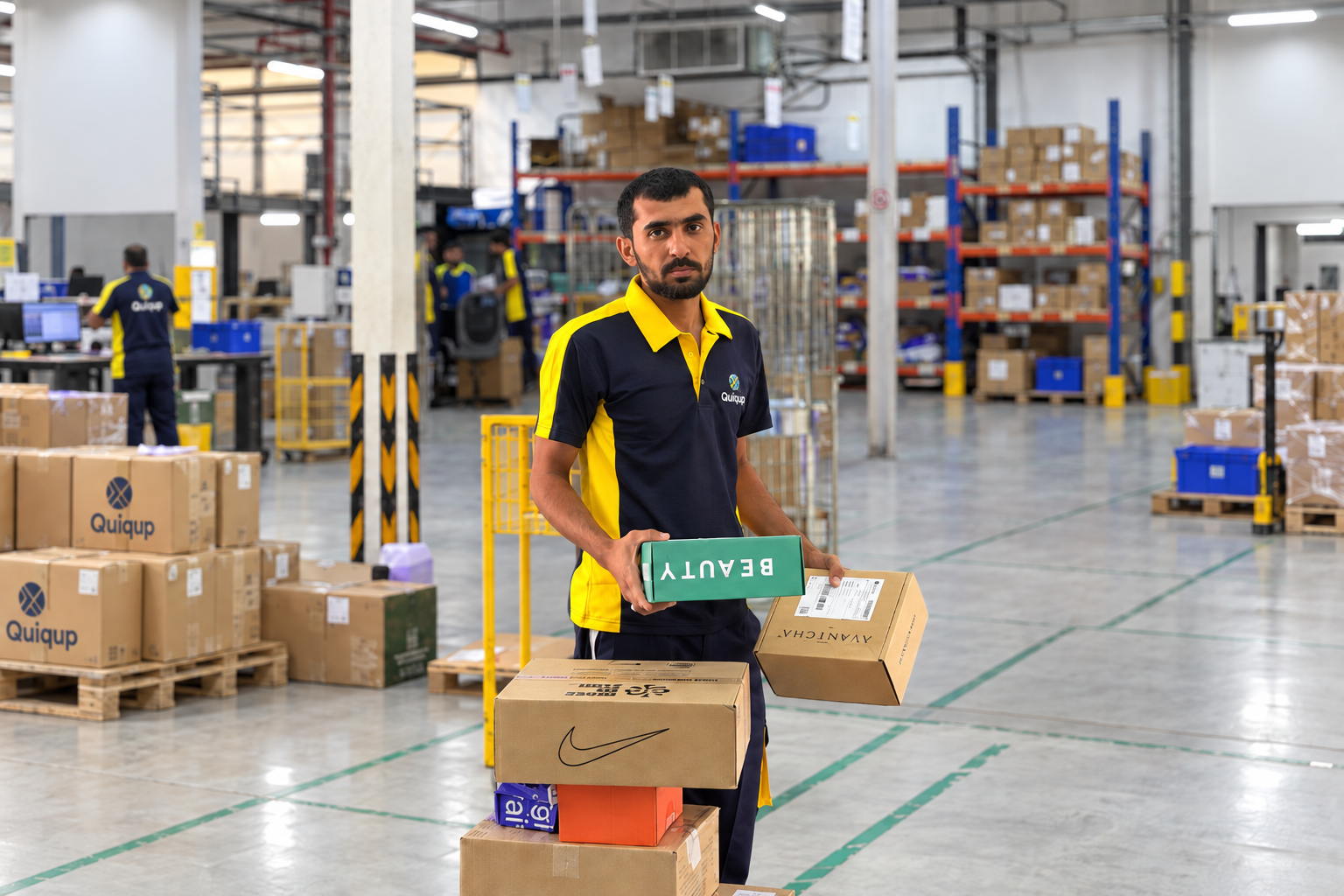
Quiqup provides integrated e-commerce fulfillment from a UAE base, covering storage, picking, packing, delivery, and returns within a single operational flow. Fulfillment is designed to work hand-in-hand with last-mile delivery rather than as a separate handoff, which is particularly relevant for brands offering same-day or next-day delivery.
The setup is built around real-time inventory visibility, automated order import from platforms like Shopify and WooCommerce, and dispatch workflows aligned to delivery cut-offs. This makes it a practical option for brands where fulfillment speed directly affects conversion and customer satisfaction.
Typical use cases:
- D2C brands shipping daily
- Same-day or next-day delivery models in the UAE
- Operations where fulfillment and delivery need to behave like one system
- Brands that want fewer operational handovers and clearer accountability
For brands evaluating whether a tightly integrated fulfillment-and-delivery model fits their order patterns, Quiqup offers consultations to review volumes, cut-offs, and delivery expectations before committing. It’s a useful starting point if fulfillment speed is becoming a growth lever rather than just a cost center.
RSA Global
Best fit: Structured e-commerce operations with multiple sales channels
RSA Global runs fulfillment operations in the UAE that are designed for online retail, often supporting brands selling both D2C and through marketplaces. Inventory accuracy, process discipline, and formal SLAs tend to be strong points.
This is a common choice when operations are growing more complex and need structure without jumping straight to enterprise contract logistics.
Typical use cases:
- Multi-SKU e-commerce brands
- D2C plus marketplace sales
- Brands that need integrations, QC, and defined returns flows
Shipa Ecommerce
Best fit: Brands with a strong cross-border focus
Shipa Ecommerce is often considered when international lanes matter early on. Its positioning is closely tied to cross-border fulfillment and coordination, making it relevant for UAE brands shipping across the GCC or beyond.
It’s less about ultra-fast local delivery and more about handling regional complexity cleanly.
Typical use cases:
- UAE brands expanding regionally
- Cross-border e-commerce from day one
- Tech-enabled fulfillment setups
Fulfilled by Noon (FBN)
Best fit: Brands selling primarily on Noon
FBN is not a general 3PL. It’s a marketplace fulfillment program designed to improve seller performance inside Noon’s ecosystem.
Inventory is stored and fulfilled through Noon’s network, and the value is mostly marketplace-specific.
Typical use cases:
- Noon-heavy sales mix
- Marketplace-driven fulfillment strategy
- One node within a broader setup, not a replacement for D2C fulfillment
Contract logistics and large 3PL providers
These providers operate large warehouses and long-term logistics programs. They can support e-commerce, but they are not always optimized for fast-moving D2C workflows by default.
Aramex
Best fit: Regional operations and mixed B2B/B2C flows
Aramex offers contract logistics and warehousing in the UAE and has supported e-commerce as part of broader supply chain setups. It’s often chosen for regional reach and infrastructure depth rather than pure D2C speed.
Typical use cases:
- Brands combining B2B, retail, and e-commerce
- GCC-wide logistics programs
- Heavier, more complex supply chains
DHL Supply Chain
Best fit: Large, structured, enterprise environments
DHL Supply Chain runs large multi-user facilities in the UAE with strong governance, reporting, and compliance. It’s well suited to predictable, high-volume operations — less so to early-stage or highly dynamic D2C brands.
Typical use cases:
- Global or enterprise brands
- Strict SLA and compliance needs
- Long-term contract logistics programs
CEVA Logistics
Best fit: Brands scaling toward enterprise operations
CEVA has expanded its UAE footprint and increasingly supports e-commerce customers, while still operating primarily as a contract logistics provider. Standardization and scalability are key strengths.
Typical use cases:
- Growing regional brands
- Structured warehouse programs
- Operations prioritising consistency over flexibility
Emirates Logistics
Best fit: Warehousing combined with distribution
Emirates Logistics provides warehousing and fulfillment alongside broader logistics services. It’s often relevant when e-commerce fulfillment is part of a wider distribution requirement rather than the main driver.
Typical use cases:
- Mixed B2B and B2C operations
- Storage plus regional distribution
- Less delivery-speed-sensitive models
DB Schenker
Best fit: Long-term, contract-led logistics programs
DB Schenker operates large facilities in the UAE and supports complex, multi-country supply chains. E-commerce fulfillment is typically one component of a wider logistics scope.
Typical use cases:
- Enterprise logistics
- Multi-country programs
- Non-D2C-first operations
UPS Supply Chain Solutions
Best fit: Distribution-led supply chains with global alignment
UPS Supply Chain Solutions offers warehousing and distribution services globally, including the UAE. It’s generally better suited to structured supply chain operations than fast-cycle D2C fulfillment.
Typical use cases:
- Distribution-heavy operations
- Global supply chain integration
- Strong reporting and governance requirements
How to choose the right fulfillment company in the UAE
The mistake most brands make is choosing based on name recognition.
Better questions to ask:
- Is this warehouse designed for e-commerce, or adapted from B2B logistics?
- How do cut-off times and dispatch SLAs actually work day to day?
- How is inventory accuracy measured and corrected?
- How do returns work operationally, not just on paper?
- How cleanly does this integrate with our store, OMS, and couriers?
Many successful UAE brands don’t rely on one provider. They split fulfillment:
- one partner for D2C
- one marketplace node
- one cross-border or regional setup
That only works if inventory sync and routing rules are designed properly.
Which fulfillment model fits you best
E-commerce-first 3PLs tend to work best when:
- you run a Shopify, WooCommerce, or Magento store
- same-day or next-day delivery affects conversion
- COD or BNPL are common payment methods
- promotions create sharp volume spikes
You usually gain speed and customer experience, with less operational friction.
Contract logistics providers make more sense when:
- volumes are high and predictable
- SKU catalogues are large or pallet-heavy
- B2B, retail, and e-commerce share the same supply chain
- governance and compliance matter more than speed
You gain structure and scalability, but with longer setup times and less flexibility.
Marketplace fulfillment (like FBN) works when:
- a large share of revenue comes from one marketplace
- improving marketplace SLAs directly impacts ranking
- you’re comfortable treating marketplace stock as a separate node
It rarely replaces a proper D2C fulfillment setup.
The “best” fulfillment company in the UAE isn’t the biggest or most well known.
It’s the one whose operations match your delivery promise, SKU behaviour, and stage of growth.
Get that alignment right early, and fulfillment becomes a lever.
Get it wrong, and it becomes a constant source of friction.





.png)