.png)

Quiqup vs Halan: Choosing the Right Delivery Partner for UAE E-Commerce
If you’re comparing Quiqup and Halan, you’re likely evaluating two very different types of logistics players.
Quiqup is positioned as an integrated e-commerce fulfilment and delivery provider in the UAE.
Halan (often known in the UAE market as Halan Delivery) operates primarily as a courier and last-mile delivery service.
Both can move parcels. The real question is whether you need delivery alone or delivery tightly integrated with fulfilment and returns workflows.
This comparison breaks down Quiqup vs Halan across delivery speed, fulfilment depth, COD handling, integrations, and operational fit.
High-Level Positioning: Integrated System vs Courier Service
At a structural level:
- Quiqup = fulfilment + delivery built for e-commerce workflows
- Halan = courier-first delivery provider serving local businesses
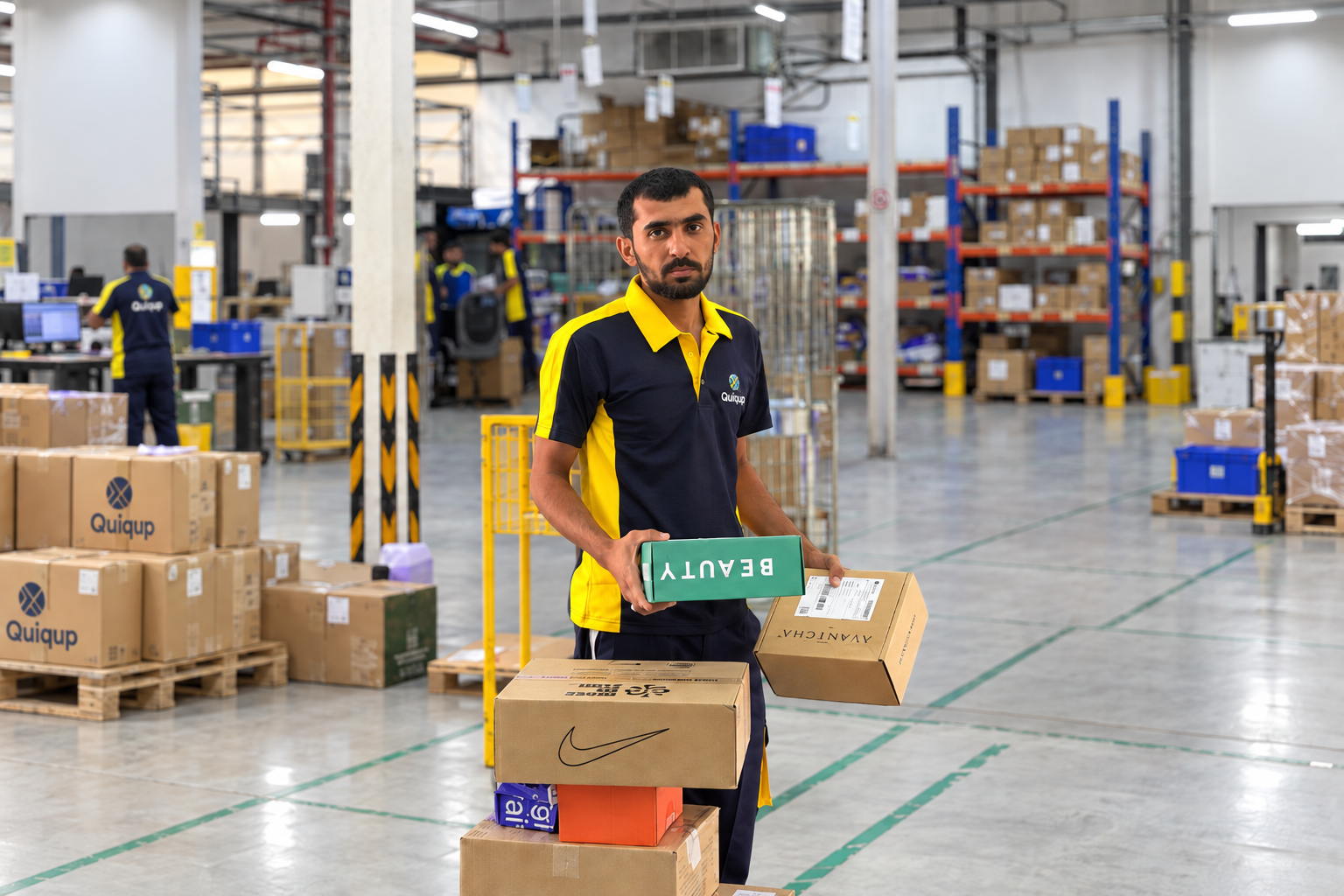
Quiqup’s model combines warehousing, pick & pack, last-mile delivery, and returns under one operational framework.
Halan focuses primarily on domestic courier services, supporting businesses that need straightforward parcel delivery across the UAE.
This distinction becomes more important as order volumes grow.
Delivery Speed and Same-Day Capabilities
Quiqup: Speed Aligned With Fulfilment
Quiqup supports same-day and next-day delivery in the UAE, with cut-offs aligned to warehouse dispatch and courier handover. Because fulfilment and delivery are coordinated, cut-off discipline is built into the system.
This is especially relevant when:
- delivery speed affects checkout conversion
- same-day is marketed as a competitive advantage
- missed cut-offs create refunds or churn
Speed is supported by workflow design — not just courier availability.
Halan: Express and Domestic Delivery
Halan provides domestic delivery services within the UAE, often supporting express and next-day options for local sellers.
This works well when:
- fulfilment is managed separately
- delivery speed is important but not tightly linked to warehouse processes
- operations are straightforward and local
Halan’s focus is on efficient last-mile execution rather than integrated fulfilment optimisation.
Fulfilment and Warehousing Depth
Quiqup Fulfilment
Quiqup offers full e-commerce fulfilment services, including:
- inventory storage
- pick & pack
- dispatch aligned with delivery SLAs
- returns processing and reintegration
This suits brands that:
- ship daily
- manage growing SKU catalogues
- rely on fast return-to-stock cycles
- want fulfilment and delivery to operate as one coordinated system
Fulfilment is a core part of the value proposition.
Halan and Fulfilment
Halan is primarily positioned as a courier and delivery provider. Fulfilment and warehousing are not typically the centre of its offering.
This makes Halan appropriate for:
- businesses that manage their own warehouse
- low-SKU or simple dispatch setups
- early-stage e-commerce brands
As SKU complexity and return volume increase, additional fulfilment infrastructure may be required beyond courier services.
Tech Stack and Integrations
Quiqup
Quiqup integrates with major e-commerce platforms such as Shopify and WooCommerce, supporting:
- automated order syncing
- unified fulfilment and delivery visibility
- real-time tracking
This reduces manual coordination and supports scaling D2C operations.
Halan
Halan provides shipment tracking and operational tools focused on delivery status and COD management.
This supports:
- parcel-level tracking
- courier visibility
However, deeper integration with warehouse systems depends on the merchant’s internal setup.
COD Handling and Returns
Quiqup
Quiqup is structured for COD-heavy UAE e-commerce, offering:
- doorstep payment collection
- reattempt management
- returns routed back into fulfilment inventory
This shortens cash cycles and speeds up restocking.
Halan
Halan supports COD delivery as part of its courier services.
This works well when:
- COD volumes are moderate
- return-to-stock speed is not operationally critical
- fulfilment is handled separately
As volume grows, reconciliation and coordination can require more internal effort.
Pricing and Commercial Considerations
Comparing rate cards alone doesn’t capture operational impact.
- Quiqup’s pricing model reflects integrated fulfilment and delivery coordination.
- Halan’s pricing model reflects courier-based domestic delivery services.
The difference often shows up in:
- operational overhead
- missed cut-offs
- return processing time
- internal workload
Lower courier rates don’t always translate into lower total cost.
When Quiqup Is the Better Fit
Quiqup typically fits best when:
- you run a scaling D2C e-commerce brand
- same-day or next-day delivery affects conversion
- fulfilment and delivery need to be tightly coordinated
- COD and return volumes are growing
- you want fewer operational handovers
When Halan Is the Better Fit
Halan may be suitable when:
- you operate your own warehouse
- delivery needs are domestic and straightforward
- SKU complexity is limited
- volumes are predictable
Can Brands Combine Both?
Yes.
Some brands:
- use Quiqup for fulfilment and core D2C delivery, and
- use Halan for specific delivery lanes or overflow capacity
This requires clear routing rules and inventory visibility.
Final Verdict: Quiqup vs Halan
This comparison isn’t about which company can deliver a parcel.
It’s about whether you need delivery alone or delivery integrated with fulfilment and returns as a single system.
If your growth depends on speed, structured fulfilment, and disciplined cut-offs, Quiqup typically aligns better.
If you primarily need reliable domestic courier services while managing fulfilment independently, Halan may be sufficient.
The right choice depends on whether delivery is just transportation — or a core part of your e-commerce experience.







.png)