.png)

eCommerce Fulfilment Solutions in the UAE: Services, Process, Technology & How to Choose
Fulfilment is where ecommerce becomes real.
Marketing drives demand, but fulfilment decides whether that demand turns into a good customer experience—or a refund.
In the UAE, expectations are high. Customers are used to fast delivery, clear tracking, and smooth returns. That means fulfilment is no longer just a backend function. It’s part of the product.
If you’re scaling an ecommerce business in Dubai or across the UAE, choosing the right fulfilment setup—whether in-house or through a 3PL—is one of the most important operational decisions you’ll make.
What are eCommerce fulfilment solutions?
eCommerce fulfilment covers everything that happens after a customer places an order:
- storing inventory
- picking and packing products
- shipping orders
- delivering to the customer
- handling returns
A fulfilment partner (3PL) takes over these operations so you don’t have to run your own warehouse and delivery network.
In practice, fulfilment solutions are about turning orders into deliveries—consistently, accurately, and at scale.
Core services included in UAE fulfilment solutions
Not all fulfilment providers offer the same depth of service. But most ecommerce-focused 3PLs in the UAE cover a similar set of core functions.
Warehousing and inventory storage
This is the foundation.
Inventory is stored in a warehouse, often in Dubai or nearby logistics hubs. Depending on your product, storage can include:
- standard pallet or shelf storage
- secure storage for high-value goods
- temperature-controlled environments for cosmetics, supplements, or food
Location matters. Warehouses closer to urban areas enable faster delivery, while larger facilities outside cities may reduce storage costs.
Order processing (pick, pack, and quality control)
When an order comes in:
- items are picked from storage
- packed according to defined standards
- checked for accuracy and quality
This is where operational discipline matters most.
Good fulfilment providers offer:
- consistent pick-and-pack processes
- low error rates
- options for branded packaging
- kitting and bundling for promotions or subscriptions
Shipping and last-mile delivery
Once packed, orders are handed off for delivery.
In the UAE, delivery speed is a major differentiator. Most ecommerce setups aim for:
- same-day delivery (within cities)
- next-day delivery (across emirates)
Reliable last-mile delivery is what turns fulfilment into a customer experience.
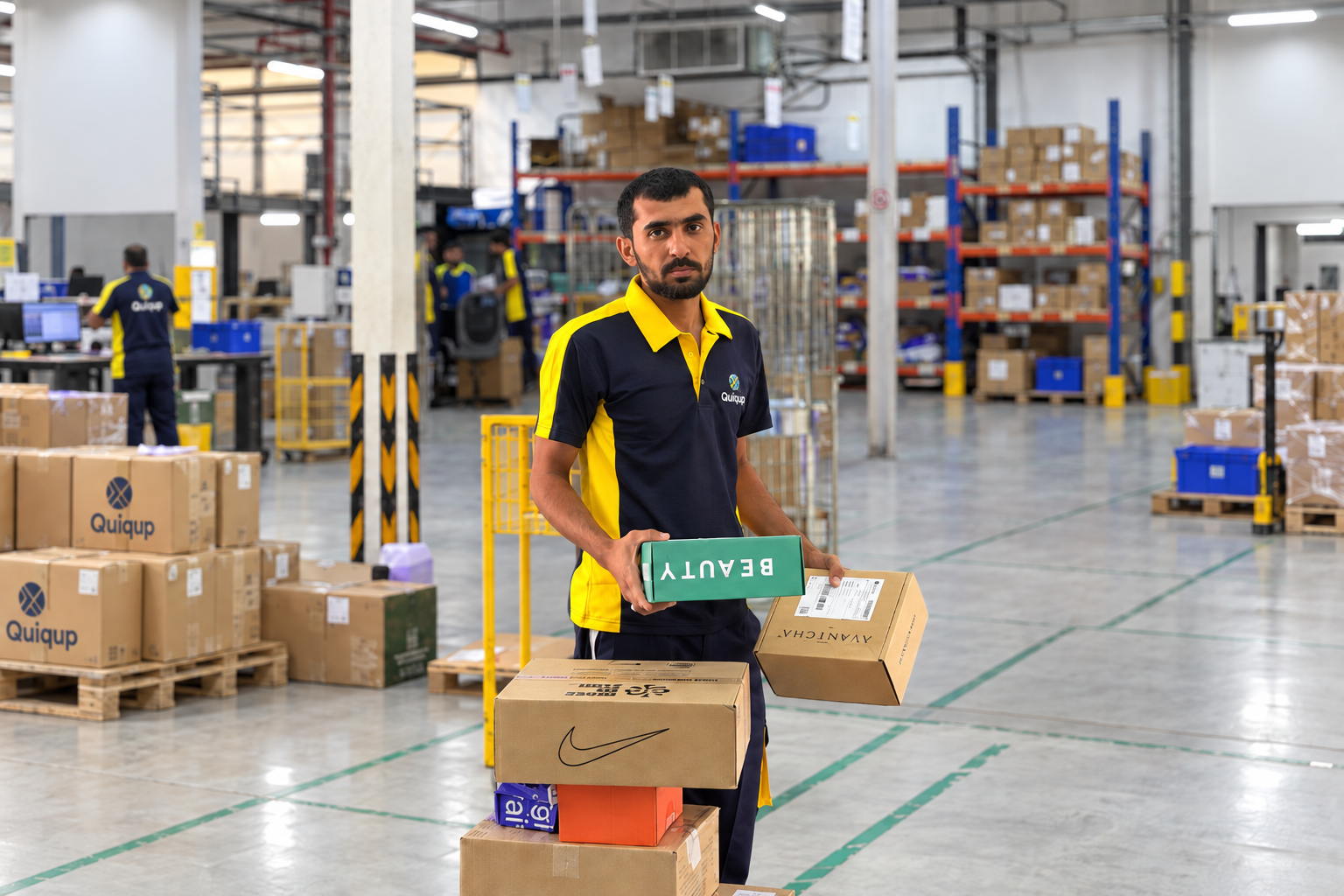
This is where integrated providers like Quiqup stand out—connecting warehouse operations directly with delivery, reducing handovers and delays.
Returns and reverse logistics
Returns are part of ecommerce. Ignoring them is a mistake.
A proper fulfilment setup includes:
- return request handling
- pickup or drop-off coordination
- inspection and grading
- restocking or disposal
Returns are operationally complex, but they directly affect customer trust and repeat purchases.
Cross-border and GCC fulfilment
Many UAE brands expand into:
- Saudi Arabia
- Kuwait
- Qatar and Bahrain
Fulfilment solutions often extend to:
- cross-border shipping
- customs coordination
- multi-country delivery setups
This becomes important once local growth stabilizes.
How the fulfilment process works
A good fulfilment operation follows a structured flow. Understanding it helps you evaluate providers properly.
Step 1 — Integrate your store
Your ecommerce platform (Shopify, WooCommerce, Magento) connects to the fulfilment system.
Orders flow automatically into the warehouse system, reducing manual work.
Step 2 — Receive and verify inventory
When stock arrives:
- quantities are checked against purchase orders
- items are scanned into the system
- discrepancies are flagged
This step affects everything downstream. Poor inbound control leads to inventory issues later.
Step 3 — Store and manage inventory
Inventory is organized within the warehouse for efficient picking.
Modern setups provide:
- real-time stock visibility
- SKU-level tracking
- alerts for low stock
You should always know what’s available and where.
Step 4 — Pick, pack, and dispatch
Orders are processed based on defined workflows:
- single-order picking for smaller volumes
- batch or wave picking for scale
Packing follows specific rules depending on product type and brand requirements.
Once ready, orders are dispatched to delivery.
Step 5 — Delivery with tracking
Customers expect visibility.
A strong fulfilment setup includes:
- real-time tracking
- delivery notifications
- proof of delivery
Tracking isn’t just operational—it’s part of the customer experience.
Step 6 — Returns processing
Returned items are:
- received
- inspected
- categorized
From there, they are:
- restocked
- refurbished
- or removed from inventory
A slow or unclear returns process creates friction for both the business and the customer.
Technology you should expect
Fulfilment today is driven by systems, not spreadsheets.
Warehouse Management System (WMS)
A WMS controls:
- inventory tracking
- order processing
- stock movements
It provides visibility into operations and helps reduce errors.
Multi-channel integrations
Your fulfilment system should connect directly with:
- Shopify
- WooCommerce
- Magento
- marketplaces like Amazon or Noon
This ensures orders, inventory, and tracking stay synchronized.
Automation and efficiency
Automation doesn’t always mean robotics.
In many cases, it’s about:
- optimized picking routes
- barcode scanning
- reduced manual input
Automation matters most when volume increases and speed becomes critical.
How to choose the right fulfilment partner in the UAE
Most businesses choose based on price or brand name.
That’s usually where problems start.
Coverage and delivery speed
Ask:
- can they support same-day or next-day delivery?
- do they cover all emirates reliably?
- how do they handle peak demand?
Speed is not just about promises—it’s about consistency.
Inventory accuracy and visibility
You need:
- real-time inventory tracking
- clear reporting
- low error rates
If stock data isn’t reliable, everything else breaks.
Returns capability
Returns handling is often underdeveloped.
Check:
- how returns are processed
- how quickly items are restocked
- how refunds and exchanges are handled
Value-added services
Depending on your business, you may need:
- kitting and bundling
- branded packaging
- gift wrapping
- labeling
These are not extras—they affect customer perception.
Storage flexibility
Look at:
- storage pricing models
- ability to scale space up or down
- support for specific product requirements (fragile, temperature-sensitive)
Scalability
Your fulfilment setup should handle:
- seasonal peaks
- sales campaigns
- sudden growth
If a provider struggles during spikes, it will affect your revenue.
Pricing transparency
Understand how pricing works:
- storage fees
- pick and pack costs
- delivery charges
- returns processing fees
Hidden costs often appear later, not in initial quotes.
Responsibilities: merchant vs fulfilment partner
One area that’s often unclear is who does what.
Merchant responsibilities
- demand planning and forecasting
- product quality
- pricing and promotions
- customer communication
3PL responsibilities
- inventory storage
- order processing
- dispatch and coordination with couriers
- returns handling
Shared responsibility
- delivery performance
- customer experience
- issue resolution
The best setups work as a system, not as separate pieces.
Cross-border and compliance considerations
Once you move beyond the UAE, complexity increases.
When you need additional support
You may need help with:
- customs documentation
- duties and taxes handling
- product restrictions
- cross-border returns
Not all fulfilment providers handle this well.
Impact on operations
Cross-border adds:
- longer delivery times
- higher costs
- more failure points
It needs to be planned carefully, not added as an afterthought.
Performance metrics to track
To evaluate fulfilment properly, track the right metrics.
Core operational KPIs
- order accuracy rate
- order-to-dispatch time
- delivery success rate
- return rate
- returns processing time
Customer-facing metrics
- delivery time vs promise
- tracking engagement
- customer complaints related to delivery
Fulfilment performance should be measured continuously, not occasionally.
FAQs
How does an ecommerce fulfilment center work in Dubai?
A fulfilment center stores inventory, processes orders, and coordinates delivery. Orders flow from your ecommerce platform into the warehouse system, where they are picked, packed, and shipped.
What products can be stored?
Most fulfilment centers handle a wide range of products, including small items, bulky goods, fragile items, and some temperature-sensitive products depending on the facility.
Can fulfilment providers handle high volumes?
Yes, but capacity varies. It’s important to confirm how providers handle seasonal spikes and large campaigns.
Do fulfilment providers offer international shipping?
Many support GCC and international shipping, but capabilities differ. Cross-border operations often require additional setup.
How do integrations work?
Most providers integrate with ecommerce platforms via APIs or apps. Orders and inventory sync automatically.
Can I start with low order volumes?
Some providers support smaller businesses, while others focus on higher volumes. Minimums vary.
Do fulfilment providers offer branded packaging?
Many offer customization options such as branded boxes, inserts, and labeling.
Can customers track deliveries?
Yes. Modern fulfilment setups include real-time tracking and delivery updates.
How are returns handled?
Returns are processed through inspection, sorting, and restocking or disposal. The exact workflow depends on the provider.
Fulfilment is not just logistics. It’s a core part of your product.
In the UAE, where delivery expectations are high, the difference between a good and bad fulfilment setup is visible to customers immediately.
A strong fulfilment partner should:
- integrate cleanly with your systems
- maintain accurate inventory
- deliver consistently on time
- handle returns efficiently
When everything works together—inventory, warehouse, and delivery—you get predictable operations and better customer retention.
When it doesn’t, problems show up fast.
Choose based on how the system works in practice, not how it looks on paper.








.png)