.png)
Courier vs Freight in the UAE: What’s the Difference & Which One Should You Choose?
If you’re shipping something in the UAE, one of the first decisions you’ll face is simple on the surface but easy to get wrong:
Should you use a courier or freight?
Both move goods from A to B. But they operate very differently, and choosing the wrong one affects cost, delivery speed, customer experience, and operational complexity.
For most businesses, especially in e-commerce, the line between the two becomes clearer once you understand how each works in practice.
Why choosing the right delivery method matters
The delivery method you choose impacts:
- how fast your shipment arrives
- how much you pay
- how much effort is required to manage it
- how your customer experiences delivery
For example:
- choosing freight for a small urgent parcel slows everything down
- choosing courier for large bulk shipments becomes unnecessarily expensive
Getting this decision right early helps avoid inefficiencies as you scale.
What is a courier service?
A courier service is designed for fast, door-to-door delivery of parcels and small shipments.
How courier services work
Courier services typically operate their own delivery network, handling the shipment from pickup to final delivery.
That includes:
- collecting the parcel from your location
- sorting it through local hubs
- delivering it directly to the recipient
The key characteristic is simplicity: one provider manages the entire journey.
Best use cases for courier in the UAE
Courier services are ideal for:
- e-commerce orders
- documents and legal papers
- small parcels and packages
- samples or prototypes
- time-sensitive deliveries
In the UAE, courier services are heavily used for same-day and next-day delivery, especially within cities like Dubai and Abu Dhabi.
Key courier benefits
Courier services are built for speed and visibility.
Typical advantages include:
- fast delivery (same-day or next-day options)
- real-time tracking at parcel level
- door-to-door convenience
- flexible delivery windows
- high delivery success rates when properly managed
For businesses, especially D2C brands, this directly affects conversion and customer satisfaction.
Platforms like combine fulfilment and courier delivery into a single flow, which reduces handovers and improves delivery consistency.
What is freight shipping (and cargo services)?
Freight shipping is designed for moving large, heavy, or bulk shipments over longer distances.
How freight works
Freight typically involves multiple transport methods:
- trucks (road freight)
- planes (air freight)
- ships (sea freight)
Unlike courier services, freight is usually not door-to-door by default. It often involves multiple parties handling different parts of the journey.
What is typically shipped via freight
Freight is used for:
- pallets and crates
- containers
- machinery and equipment
- furniture
- construction materials
- bulk inventory
This is not about individual parcels. It’s about moving volume efficiently.
Key freight benefits
Freight becomes the better option when scale increases.
Advantages include:
- lower cost per unit for large shipments
- flexibility across transport modes
- ability to handle heavy and oversized goods
- support for international trade and bulk distribution
However, this comes with more complexity.
Freight forwarder vs courier vs carrier (clear roles)
There’s often confusion between these terms. Here’s how they differ.
Freight forwarder = coordinator
A freight forwarder does not usually move goods directly.
Instead, they:
- plan routes
- book carriers
- manage documentation
- coordinate customs
- arrange consolidation and warehousing
They act as the orchestrator of the shipment.
Carrier = transport operator
A carrier is the company that physically moves the goods.
Examples include:
- trucking companies
- shipping lines
- airlines
They typically operate hub-to-hub, not full door-to-door.
Courier = end-to-end operator
A courier handles the full delivery cycle:
- pickup
- sorting
- last-mile delivery
This is why courier services are simpler to use for smaller shipments.
Courier vs Freight: side-by-side comparison
FactorCourierFreightShipment sizeSmall parcelsLarge, heavy, bulkDelivery speedSame-day / next-dayDays to weeksCost modelHigher per parcelLower per unit at scaleTrackingDetailed, parcel-levelLess granularConvenienceDoor-to-doorMore coordination requiredHandlingSuitable for fragile/high-valueDesigned for bulk transportInternational useSmall shipmentsLarge cross-border tradeDocumentationMinimalMore complex (customs, paperwork)
Which should you choose in the UAE?
This is where most decisions become straightforward.
Choose courier if…
- your shipment is small or medium-sized
- delivery speed matters
- you need real-time tracking
- you want a simple, door-to-door process
- you’re running an e-commerce business
For most UAE-based online stores, courier services are the default.
Choose freight if…
- your shipment is large or palletised
- you’re moving bulk inventory
- cost efficiency matters more than speed
- you’re shipping internationally at scale
Freight becomes relevant once you move beyond parcel-level operations.
If you need coordination, customs, or consolidation…
You’re likely in freight forwarder territory.
That typically applies when:
- you’re importing or exporting goods
- you need documentation support
- you’re combining shipments
- you’re managing a supply chain rather than individual deliveries
A practical UAE perspective
In the UAE, most businesses don’t choose between courier and freight once.
They use both at different stages.
Typical setup:
- Freight brings inventory into the UAE (bulk shipments)
- Courier handles last-mile delivery to customers
This split is especially common for e-commerce brands.
For example:
- inventory arrives in bulk via freight
- stock is stored locally
- orders are fulfilled and delivered via courier
This is where integrated fulfilment and delivery solutions matter, because they connect storage, picking, and last-mile delivery into one system.
Questions to ask before booking
If you’re unsure which option to use, ask yourself:
- What is the size and weight of the shipment?
- How urgent is the delivery?
- Do I need door-to-door simplicity or can I manage multiple steps?
- Is this a one-off shipment or part of a recurring flow?
- Do I need help with customs, documentation, or consolidation?
Your answers usually point clearly to either courier or freight.
Where Quiqup fits
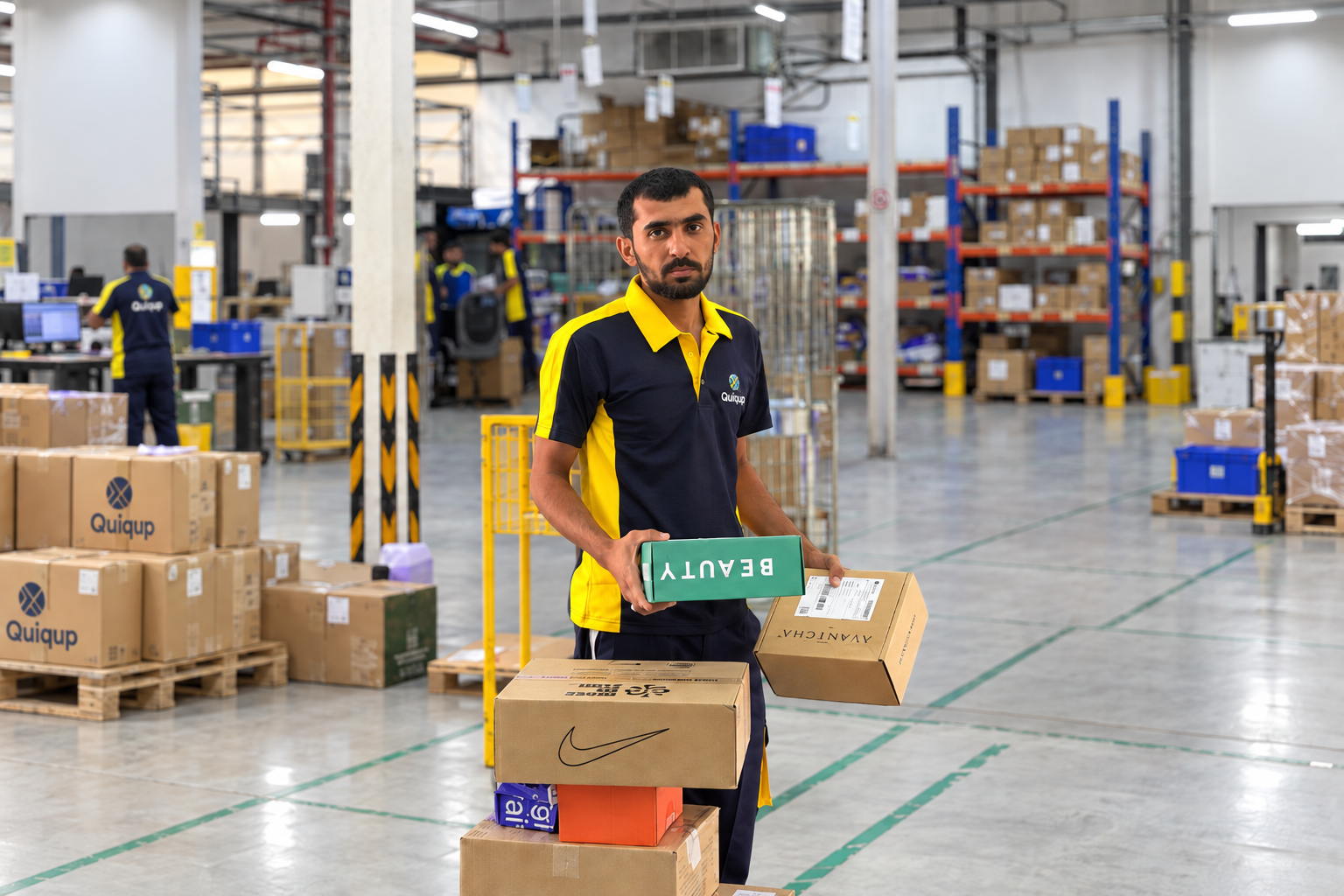
Quiqup operates in the courier and fulfilment layer.
That means it’s designed for:
- e-commerce delivery
- same-day and next-day shipments
- reliable last-mile operations
- integration with online stores
For businesses that already have inventory in the UAE, the focus shifts from moving goods in bulk to delivering orders consistently and efficiently to customers.
That’s where courier services—and especially integrated fulfilment + delivery—become critical.
Conclusion: choosing the right service
The difference is simple once you break it down:
- Courier = speed, simplicity, and parcel-level delivery
- Freight = scale, efficiency, and bulk movement
If you’re shipping individual orders, especially in the UAE, courier is almost always the right choice.
If you’re moving large volumes across regions, freight becomes necessary.
Most growing businesses end up using both—but at different stages of the supply chain.
The key is knowing where one ends and the other begins.







.png)