.png)
In-House vs 3PL Fulfillment in the UAE: Which Model Fits Your Business?
At some point, every growing ecommerce brand hits the same operational question:
Should we keep fulfillment in-house, or outsource it to a 3PL?
Early on, doing everything yourself can feel natural. You know the products, you control the packing, and you can personally fix mistakes. But as order volume grows, fulfillment starts taking more time, more space, and more management attention than expected.
That is when the trade-off becomes real.
In-house fulfillment gives you control.
A 3PL gives you infrastructure, systems, and scalability.
The right answer depends on your stage, product type, order volume, delivery promise, and how much operational complexity you want to manage yourself.
For UAE brands, the decision is even more important because customers expect fast delivery, clear tracking, and simple returns. Fulfillment is no longer just a warehouse function. It affects conversion, retention, and brand reputation.
What a 3PL Does
A third-party logistics provider, or 3PL, manages logistics operations on behalf of a business.
For ecommerce, this usually includes:
- warehousing
- inventory storage
- picking and packing
- dispatch
- delivery coordination
- returns handling
Some 3PLs focus mostly on storage and warehouse operations. Others connect fulfillment directly with last-mile delivery, tracking, and returns.
That distinction matters.
A basic warehouse provider may store and prepare orders, but you still need separate courier coordination. An integrated fulfillment partner connects the flow from stock storage to final delivery, reducing the handovers between systems and teams.
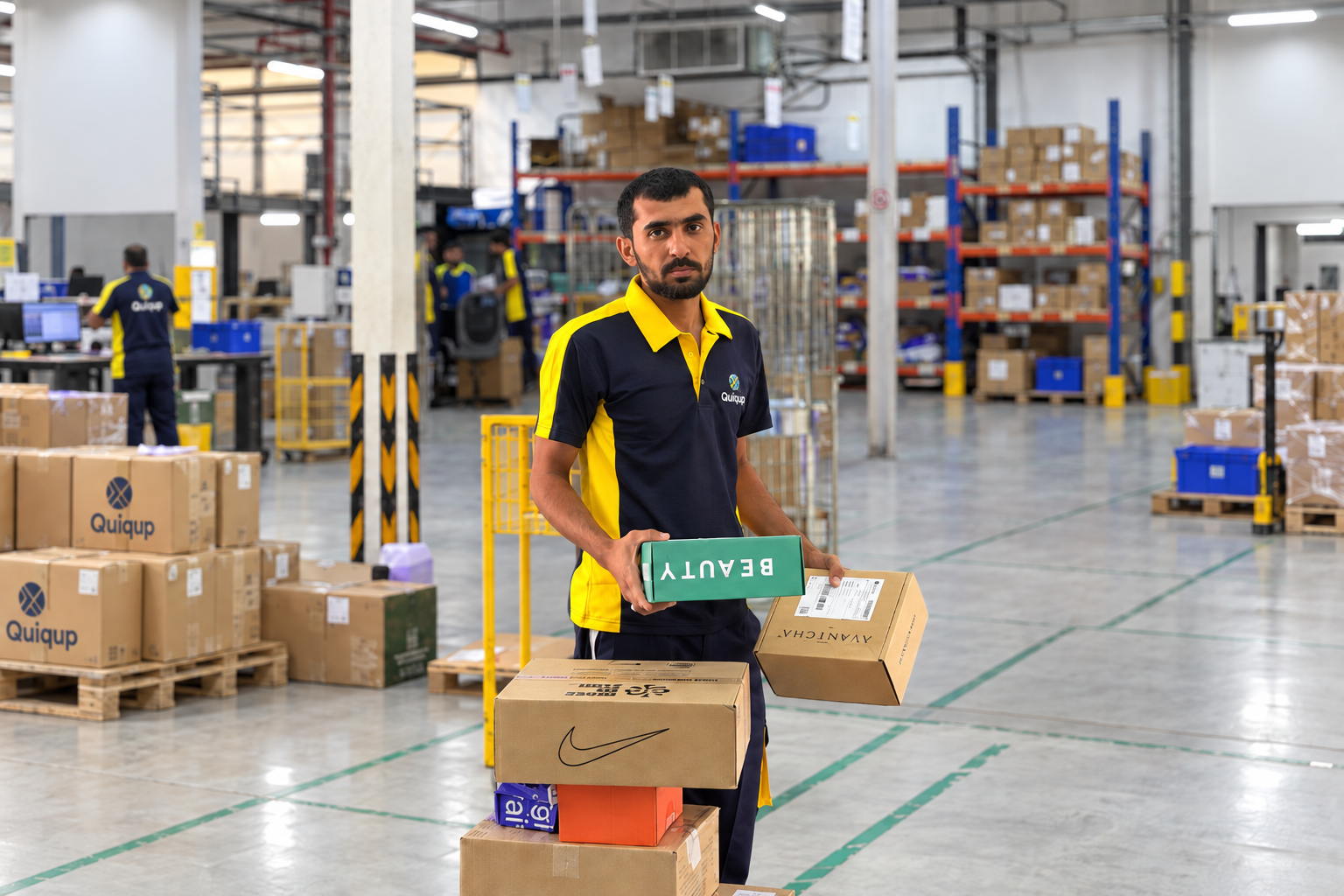
Quiqup operates in that integrated layer: ecommerce fulfillment from a Dubai-based center, including storage, pick and pack, delivery, tracking, and returns.
Why Fulfillment Strategy Matters as You Scale
Fulfillment decisions show up in places founders often underestimate:
- delivery speed
- inventory accuracy
- customer support workload
- shipping cost
- packaging consistency
- returns processing
- ability to handle peak periods
When fulfillment is working, customers barely notice it. They order, receive updates, and get the parcel when expected.
When fulfillment breaks, it becomes very visible:
- late dispatch
- wrong items sent
- missed cut-offs
- failed deliveries
- slow refunds
- “Where is my order?” tickets
As your order volume grows, fulfillment becomes less about packing boxes and more about operating a repeatable system.
Option 1: In-House Fulfillment
In-house fulfillment means your team manages the process directly.
You store inventory, pick orders, pack parcels, book couriers, manage returns, and handle operational issues yourself.
This is common for early-stage brands, niche products, and businesses that want tight control over the customer experience.
Benefits of In-House Fulfillment
More Control Over Operations
The biggest advantage is control.
You decide:
- where inventory is stored
- how orders are packed
- how quality checks happen
- when parcels are dispatched
- how returns are inspected
If something goes wrong, your team can respond immediately.
This matters for brands with unusual products, fragile items, or highly customized orders.
Better Customization
In-house operations make it easier to handle:
- handwritten notes
- gift wrapping
- product personalization
- made-to-order items
- special packaging rules
- fragile or delicate products
If every order is slightly different, in-house fulfillment may feel more flexible than outsourcing.
A 3PL can often support custom packaging, kitting, and branded inserts, but complexity usually needs to be defined clearly and may affect pricing.
Direct Visibility Into Stock and Quality
When stock sits in your own space, it is easier to inspect, count, and adjust.
You can walk to the shelf and check.
That visibility can be useful early on, especially before you have proper systems in place.
Direct Carrier Relationships
If you manage fulfillment yourself, you can choose and negotiate directly with courier partners.
This gives you flexibility, but it also means your team owns the operational work:
- booking pickups
- printing labels
- tracking issues
- reconciling failed deliveries
- managing returns
That workload grows quickly.
Trade-Offs of In-House Fulfillment
High Fixed Costs
In-house fulfillment comes with fixed overhead.
Cost categories can include:
- warehouse or storage rent
- staff salaries
- utilities
- insurance
- packing materials
- shelving and equipment
- software
- barcode scanners
- vehicles or pickup coordination
- management time
These costs exist whether you ship 100 orders or 1,000 orders.
At low volume, this may be acceptable. At fluctuating volume, it can become inefficient.
More Management Time
Fulfillment can quietly consume leadership attention.
Instead of focusing on:
- product development
- marketing
- partnerships
- customer acquisition
the team spends time on:
- courier follow-ups
- stock checks
- packing issues
- returns
- staffing
- dispatch bottlenecks
That may be fine early on. But once fulfillment starts slowing down growth, the model needs to be reviewed.
Scaling Is Slow and Capital-Intensive
Growth creates new requirements:
- more space
- more people
- better systems
- stronger SOPs
- more courier coordination
If order volume spikes during Ramadan, Black Friday, seasonal campaigns, or influencer-driven sales, an in-house setup can become overwhelmed.
Hiring, training, and expanding space takes time. A lease or warehouse setup that works today may not fit six months later.
Option 2: Outsourced 3PL Fulfillment
A 3PL handles fulfillment operations for you.
Instead of building warehouse infrastructure internally, you use a partner that already has space, systems, people, and processes.
Benefits of Using a 3PL
Lower Operational Burden
The main benefit is that you avoid building everything yourself.
A 3PL can manage:
- storage
- receiving
- inventory handling
- picking
- packing
- dispatch
- returns
This frees your team to focus on growth.
For many ecommerce brands, this is the turning point: fulfillment stops being a daily internal bottleneck and becomes a managed operational function.
Access to Systems and Processes
Modern fulfillment depends on technology.
A good 3PL should offer:
- inventory visibility
- order syncing
- barcode-enabled workflows
- automated dispatch processes
- tracking updates
- returns visibility
Quiqup, for example, supports integrations with platforms including Shopify, WooCommerce, Opencart, Prestashop, Salla, Salesforce Commerce Cloud, and Magento. Shopify and WooCommerce brands can also connect through native connectors, while custom platforms can use API-based implementation.
The value is not just automation. It is fewer manual steps and fewer places for errors to enter.
Faster Delivery Through Integrated Operations
If fulfillment and delivery are disconnected, delays often happen between the warehouse and courier.
A 3PL with integrated delivery can reduce that friction.
Quiqup’s fulfillment model connects storage, pick and pack, delivery, tracking, and returns into one operational flow. For UAE ecommerce brands, this matters because same-day and next-day delivery depend on cut-offs, dispatch timing, and courier handover working together.
When warehouse and delivery teams are aligned, it becomes easier to protect delivery promises.
Scalability During Peaks
A major advantage of outsourcing is flexibility.
When volumes increase, a 3PL can usually scale more easily than a small in-house team because it already operates fulfillment infrastructure.
This is especially relevant during:
- Ramadan
- sales campaigns
- seasonal promotions
- product launches
- influencer spikes
Quiqup’s fulfillment service is positioned to support peak periods, including higher order volumes during busy seasons.
Returns Handling
Returns are easy to underestimate.
A proper 3PL can handle:
- return collection
- inspection
- restocking
- customer updates
- reporting
Quiqup also offers returns services in the UAE, with return notifications and dashboard visibility.
This matters because returns are not just a cost. They affect customer trust and repeat purchase.
Variable Cost Structure
Unlike in-house operations, 3PL costs are often more variable.
You typically pay for:
- storage used
- orders processed
- returns handled
- value-added services
Quiqup operates on a pay-as-you-go model for fulfillment, with a minimum storage requirement equivalent to 1 cubic meter.
This can be useful for growing brands that want operational flexibility without committing to a full warehouse setup.
Trade-Offs of Using a 3PL
Less Direct Control
Outsourcing means you no longer control every detail personally.
You need to define:
- packing rules
- quality standards
- branding requirements
- return criteria
- escalation processes
If you do not document expectations, the provider will default to standard workflows.
This is not necessarily a problem. But it requires better process design upfront.
Fees Can Be Complex
3PL pricing can include several components:
- setup or onboarding
- storage
- receiving
- pick and pack
- delivery
- returns
- kitting
- special handling
- packaging materials
The key is to compare total cost, not one line item.
A cheap pick-and-pack fee may not matter if storage, returns, or delivery surcharges are unclear.
Integration and Onboarding Take Work
Even with a strong partner, onboarding needs effort.
You need to align:
- SKU data
- product dimensions
- inventory quantities
- platform integrations
- packaging requirements
- delivery service levels
- returns rules
The best 3PL relationships start with a clean onboarding process.
Quiqup requires standard business onboarding documents such as UAE trade license, bank details, and client profile, then coordinates onboarding with a dedicated fulfillment contact.
Option 3: Dedicated or More Customized 3PL Fulfillment
There is also a middle ground between standard 3PL and fully in-house operations.
A dedicated or more customized 3PL setup is designed around the brand’s specific workflows.
This can include:
- custom packing stations
- branded packaging processes
- dedicated account support
- tailored reporting
- specific courier rules
- complex kitting or bundling
- category-specific handling
This model fits brands that need both scale and a more controlled customer experience.
The trade-off is that customization usually requires more planning, closer collaboration, and potentially higher cost.
For fast-growing UAE brands, this can be the right step once standard fulfillment is no longer enough but building an internal warehouse still does not make sense.
Cost Comparison: Fixed In-House Costs vs 3PL Variable Fees
The cost question is rarely as simple as “which one is cheaper?”
It depends on volume, complexity, seasonality, and management effort.
In-House Cost Categories
If you fulfill orders yourself, include:
- rent or storage cost
- staff salaries
- packing materials
- equipment
- software
- utilities
- insurance
- admin time
- courier coordination
- returns handling
- errors and rework
Many brands forget to price management time. But if the founder or ops lead spends hours fixing fulfillment issues, that is a real cost.
3PL Cost Categories
With a 3PL, expect fees such as:
- storage fees
- receiving fees
- pick-and-pack fees
- packaging costs
- delivery charges
- returns processing
- kitting or special services
- account support or platform fees, depending on provider
Quiqup states that its fulfillment model has no subscription fee and operates on pay-as-you-go pricing.
How to Compare Apples to Apples
Use this simple method:
Total monthly fulfillment-related costs ÷ number of orders shipped = cost per fulfilled order
For in-house, include all internal costs:
- rent
- labor
- software
- packaging
- courier coordination
- returns work
- management time
For 3PL, include:
- storage
- pick and pack
- delivery
- returns
- special services
- platform or support costs if applicable
This gives a clearer comparison than looking at one fee in isolation.
Decision Framework: Questions to Answer Before Choosing
Use the following questions before deciding between in-house and 3PL fulfillment.
1) What Are Your Service Requirements?
Do you need:
- storage only?
- pick and pack?
- delivery?
- returns?
- international shipping?
- marketplace fulfillment?
The more services you need, the stronger the case for a partner.
2) What Technology Do You Need?
Ask whether you need:
- real-time inventory visibility
- Shopify or WooCommerce integration
- API connections
- order tracking
- branded delivery tracking
- automated customer notifications
If your team is still manually exporting orders and booking deliveries, that is usually a sign the current model is reaching its limit.
3) How Customized Is Your Fulfillment?
In-house may make sense if every order is highly customized.
A 3PL may make sense if your customization can be standardized into rules:
- branded box
- insert
- kitting logic
- gift note
- fragile handling
The question is not “do we need customization?”
It is “can our customization be operationalized?”
4) What Is Your SKU and Inventory Profile?
Consider:
- number of SKUs
- product size
- fragility
- expiry dates
- batch tracking
- storage needs
- turnover speed
A small number of fast-moving SKUs is easier to outsource. A complex catalog may need stronger systems and clearer SOPs.
5) What Delivery Promise Are You Making?
If your brand promises same-day or next-day delivery, fulfillment needs to support that.
Ask:
- when are orders cut off?
- when are they picked?
- when are they packed?
- when are they handed to delivery?
- what happens if a cut-off is missed?
Delivery speed depends on fulfillment discipline.
6) How Volatile Is Your Growth?
If demand is predictable, in-house may be easier to plan.
If volume fluctuates heavily because of campaigns or seasonal demand, a 3PL may provide more flexibility.
7) How Complex Are Returns?
If returns require:
- inspection
- refurbishment
- repackaging
- repair
- resale grading
you need a clear process.
You can manage this in-house, but only if you have the space, staff, and system discipline. Otherwise, a fulfillment partner with returns workflows can help.
8) How Much Control Do You Really Need?
Some brands say they want control, but what they really need is visibility.
Control means doing the work yourself.
Visibility means knowing what is happening and being able to act.
A good 3PL should provide visibility without forcing you to manage every operational detail.
Multi-Location Fulfillment: Speed vs Inventory Cost
Multi-location fulfillment can improve delivery speed by placing inventory closer to customers.
But it also creates hidden costs.
If you split stock across locations, you may need more safety stock overall.
Example:
- one warehouse may need 500 units to stay covered
- two warehouses may need 350 units each
- total stock required becomes 700 units
That ties up more cash.
Multi-location makes sense when:
- demand is predictable by region
- delivery speed materially affects conversion
- top SKUs are clear
- inventory accuracy is strong
It does not make sense if your single-location operation is already messy.
A good fulfillment partner can help you understand whether inventory should stay centralized or be split across nodes.
Hybrid Models: The Middle Ground
You do not always need to choose one model forever.
Some brands use hybrid setups.
Examples:
- keep VIP or custom orders in-house
- outsource standard ecommerce orders
- use a 3PL for peak overflow
- keep inventory in-house but outsource delivery
- use fulfillment partners for marketplace or GCC expansion
Hybrid models work best when routing rules are clear.
If nobody knows which order goes where, hybrid quickly becomes chaos.
Summary: Which Model Fits Which Stage?
In-House Fulfillment Often Fits When:
- order volume is low
- the product is highly customized
- the founder wants direct control
- warehouse complexity is limited
- delivery speed is not yet a major differentiator
Traditional 3PL Fulfillment Often Fits When:
- volume is growing
- daily operations are becoming a bottleneck
- integrations are needed
- returns are increasing
- same-day or next-day delivery matters
Dedicated 3PL Fulfillment Often Fits When:
- the brand is scaling fast
- customer experience standards are high
- packaging and workflows need customization
- operations need both control and scale
In-House May Become Strategic Again When:
- volumes are very high and predictable
- the brand has enough capital and expertise
- logistics becomes a core competitive advantage
- the business can justify owning infrastructure
Where Quiqup Fits for UAE Ecommerce Brands
Quiqup is best suited for brands that want to outsource fulfillment without disconnecting it from delivery.
That includes businesses that need:
- ecommerce storage
- pick and pack
- delivery across the UAE
- real-time tracking
- returns handling
- Shopify or WooCommerce integration
- marketplace support for Amazon and Noon sellers
- international shipping options
The core advantage is that fulfillment and delivery are connected.
For a UAE ecommerce brand, that reduces the number of operational handovers between warehouse, courier, tracking, and returns.
If your current setup depends on manual order exports, courier follow-ups, and warehouse firefighting, that is usually the point where a 3PL model becomes worth evaluating.
Final Thoughts
In-house fulfillment gives you control, but it also gives you the workload.
A 3PL gives you systems and scalability, but only if the provider is a strong operational fit.
The right decision is not about outsourcing for the sake of outsourcing. It is about choosing the model that matches your stage, product, volume, and delivery promise.
If fulfillment is still simple, in-house can work.
If fulfillment is starting to slow growth, increase mistakes, or make delivery promises harder to keep, it may be time to bring in a partner.





.png)