.png)

Outsource Fulfilment in the UAE: A Practical Guide to Choosing the Right 3PL
Outsourcing fulfilment is usually not the first operational decision an ecommerce brand makes.
Most brands start by packing orders themselves, storing products wherever there is space, and booking courier pickups manually. That works for a while. Then order volume grows, campaigns create spikes, customers expect faster delivery, and the team spends more time managing parcels than growing the business.
That is usually the point where outsourcing fulfilment starts to make sense.
For UAE ecommerce brands, the decision is especially important. Customers expect fast delivery, accurate tracking, and simple returns. If fulfilment is slow or messy, it affects the whole customer experience.
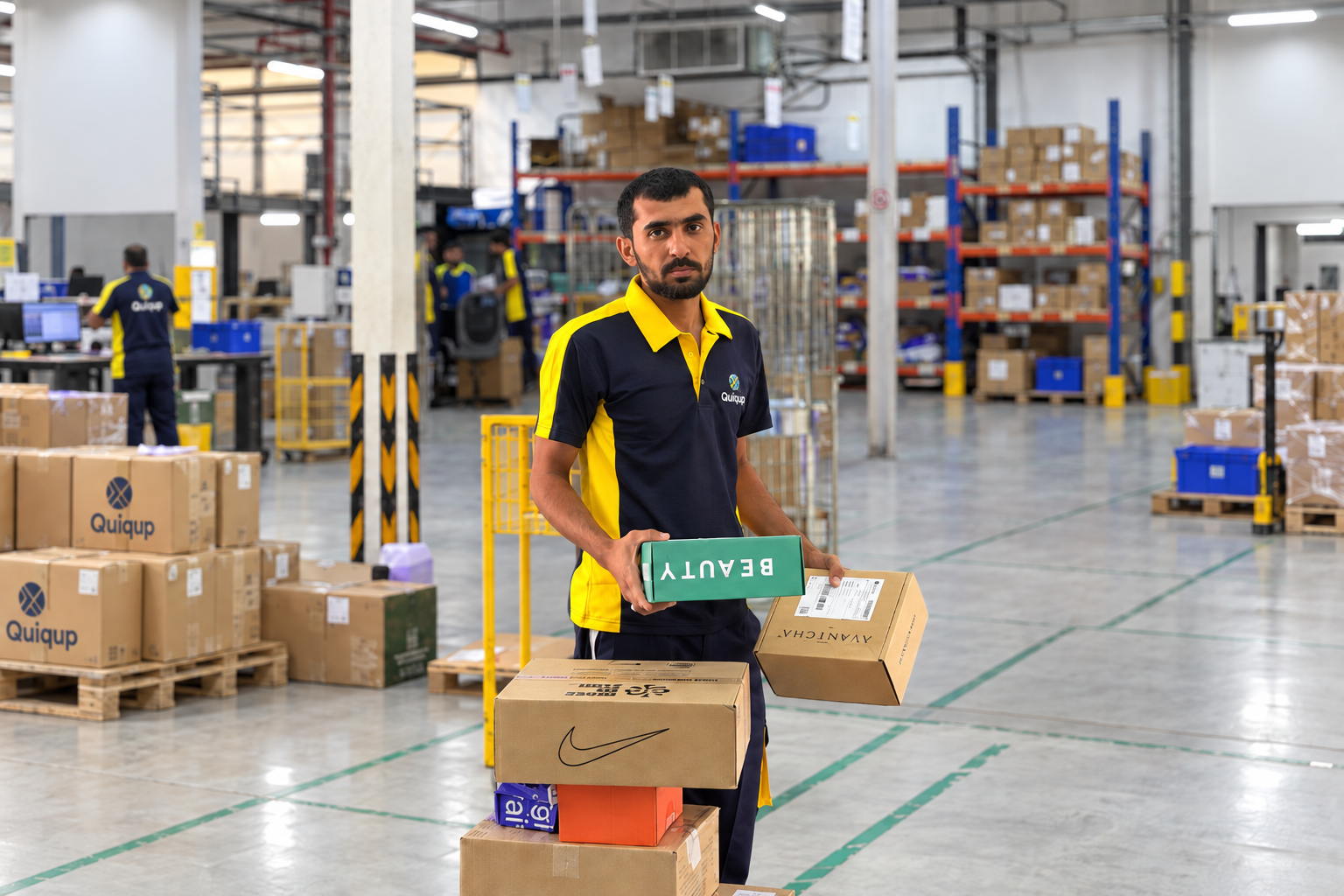
This guide explains what outsourced fulfilment includes, how the process works, what to ask providers, and where a partner like Quiqup fits for brands that want fulfilment and delivery connected in one operational flow.
What Outsourced Fulfilment Means in the UAE
Outsourced fulfilment means handing part or all of your order operations to a third-party logistics partner.
Instead of storing products, packing orders, and coordinating delivery internally, your fulfilment partner manages the operational layer.
A typical outsourced fulfilment setup includes:
- inventory storage
- inbound receiving
- pick and pack
- dispatch
- last-mile delivery
- tracking updates
- returns handling
For ecommerce brands, this is not only about warehouse space. It is about building a repeatable system for getting orders from checkout to customer without constant manual work.
Some fulfilment providers focus mainly on storage and packing. Others, like Quiqup, connect fulfilment with last-mile delivery, which is especially useful when same-day or next-day delivery matters.
Who Should Consider Outsourcing Fulfilment?
Outsourcing is usually worth evaluating when one or more of these problems start appearing:
- orders are being packed manually every day
- courier coordination takes too much time
- stock accuracy is becoming unreliable
- customers are asking where their orders are
- dispatch cut-offs are being missed
- returns are piling up
- promotions create operational pressure
- you need Shopify, WooCommerce, or marketplace orders to flow automatically
At low order volume, in-house fulfilment can be manageable. But once operations start limiting growth, outsourcing becomes less about cost saving and more about control.
The goal is not to “give away” fulfilment. The goal is to stop fulfilment from becoming a bottleneck.
The Standard Fulfilment Workflow
Most outsourced fulfilment setups follow a similar flow.
1. Onboarding and Integration
The first step is connecting your store or order system to the fulfilment provider.
For ecommerce brands, this usually means connecting platforms such as:
- Shopify
- WooCommerce
- Magento
- custom ecommerce systems through API
With Quiqup, Shopify and WooCommerce brands can use native connectors, while custom platforms can use direct API integration. Once connected, orders can flow into the fulfilment process without manual exporting or copying.
Good onboarding should also cover:
- SKU setup
- product dimensions
- inventory upload
- packaging rules
- delivery service levels
- returns process
- customer notification rules
This is where many issues are prevented before they happen.
2. Storage and Warehousing
Your products are stored at the fulfilment provider’s facility.
A proper fulfilment warehouse should support:
- organized SKU storage
- inventory visibility
- secure handling
- stock updates
- space that can scale with volume
For some categories, storage requirements are more specific. Cosmetics, supplements, packaged food, or high-value items may require stricter handling, better inventory discipline, or controlled storage conditions.
Before choosing a provider, confirm exactly what product types they can handle and what restrictions apply.
3. Pick and Pack
When an order is received, the fulfilment team picks the right products and packs them for delivery.
This stage has a direct impact on customer experience.
You should ask:
- how orders are picked
- how accuracy is checked
- whether barcode scanning is used
- whether branded packaging is supported
- whether inserts, bundles, or kitting are possible
- how fragile items are handled
A fulfilment partner should not just “pack boxes.” They should be able to follow clear operational rules that reflect your brand standards.
4. Dispatch and Delivery
After packing, the order is dispatched for delivery.
This is where the fulfilment model matters.
If your warehouse and delivery partner are separate, delays can happen between packing and courier handover. If they are integrated, the flow is tighter.
Quiqup’s model connects fulfilment with last-mile delivery, which helps align order processing, dispatch timing, and delivery tracking. For UAE brands offering same-day or next-day delivery, this connection can be more important than warehouse storage alone.
5. Tracking and Customer Visibility
Customers expect tracking.
At minimum, your fulfilment setup should provide:
- order status updates
- shipment tracking
- delivery notifications
- proof of delivery where relevant
Tracking is not just a customer feature. It also reduces support pressure.
If your team constantly has to ask the warehouse or courier for updates, the system is not doing enough.
6. Returns Processing
Returns need to be designed into the fulfilment process from the start.
A good returns workflow should include:
- return initiation
- collection or drop-off
- inspection
- restocking or quarantine
- refund or exchange trigger
- return reason reporting
Returns are where ecommerce operations often lose visibility. If returned stock is not inspected and updated quickly, inventory becomes unreliable.
Key Benefits of Outsourcing Fulfilment
Less Daily Operational Pressure
Outsourcing removes repetitive warehouse tasks from your internal team.
Instead of managing packing, pickups, tracking, and returns manually, your team can focus on:
- growth
- product
- marketing
- customer experience
- forecasting
The benefit is not only time saved. It is fewer operational distractions.
Better System Visibility
Modern fulfilment should give you visibility into:
- inventory
- orders
- delivery status
- returns
- exceptions
This matters because outsourced fulfilment only works if you can still see what is happening.
The best setup gives you operational control without requiring your team to physically manage every parcel.
More Flexible Cost Structure
In-house fulfilment often creates fixed costs:
- storage space
- staff
- equipment
- software
- management time
Outsourced fulfilment can make more of those costs variable.
You typically pay based on:
- storage used
- orders processed
- returns handled
- delivery services used
- value-added services
This is useful when order volume fluctuates.
But the pricing model needs to be clear. Hidden fees can quickly change the economics.
Faster Dispatch and Delivery
Fulfilment speed depends on process design.
A good 3PL should help with:
- order cut-offs
- picking workflows
- packing standards
- courier handover
- same-day or next-day dispatch options
In the UAE, fast delivery is often part of the value proposition. If your fulfilment setup cannot reliably meet cut-offs, your delivery promise becomes risky.
Scalability During Peaks
Sales campaigns, Ramadan, seasonal demand, and product launches can all create sudden spikes.
An in-house team may struggle to add people, space, and process quickly enough.
An outsourced fulfilment partner should already have operational capacity and peak planning processes in place.
Before signing, ask how they handle volume spikes. Do not rely on vague reassurance.
Returns Become More Manageable
Returns are often easy at 10 orders a day and painful at 500.
A fulfilment partner can help standardize:
- inspection rules
- restocking decisions
- damaged item handling
- return status updates
This protects both the customer experience and inventory accuracy.
How to Choose a UAE Fulfilment Partner
Most providers will list similar services. The difference is in execution.
Use the following checklist.
1. Operational Capabilities
Ask:
- What order volumes can you support?
- How do you handle peak periods?
- What accuracy controls are in place?
- How are picking and packing errors prevented?
- What product categories do you support?
- What products are restricted?
If a provider cannot explain the workflow clearly, that is a warning sign.
2. Technology and Visibility
You should expect:
- order dashboard
- inventory visibility
- tracking updates
- integration with ecommerce platforms
- reporting on fulfilment and delivery performance
Ask what happens when something goes wrong:
- How are exceptions flagged?
- Who is notified?
- Can your team see the issue without emailing support?
Good fulfilment technology reduces chasing.
3. Integrations
For ecommerce brands, integrations matter as much as warehouse space.
Ask whether the provider supports:
- Shopify
- WooCommerce
- Magento
- marketplaces
- API integrations
- inventory sync
- tracking sync
Quiqup supports native Shopify and WooCommerce connectors, and API integration for custom platforms. Its Shopify app also supports order and inventory syncing and shipment tracking from the Shopify dashboard.
This is important because manual order handling does not scale.
4. Commercial Model and Pricing Transparency
Do not compare providers only by pick-and-pack fee.
Ask for a full breakdown:
- storage
- receiving
- pick and pack
- packaging
- delivery
- returns
- kitting
- special handling
- account fees
- minimum commitments
- setup costs
Also ask:
- Are there monthly minimums?
- Are there long-term commitments?
- What happens if volume drops?
- What happens if volume spikes?
Transparent pricing is not about being cheapest. It is about knowing what you are committing to.
5. Delivery Coverage and Speed
Fulfilment is only useful if delivery works.
Ask:
- Do you support same-day delivery?
- Do you support next-day delivery?
- Which emirates are covered?
- What are the cut-off times?
- How are missed cut-offs handled?
- Is delivery managed internally or through separate partners?
For brands selling across the UAE, delivery coverage and reliability are central to the decision.
6. Product Fit
Not every fulfilment centre suits every product.
Clarify requirements for:
- apparel
- cosmetics
- electronics
- supplements
- packaged food
- fragile items
- bulky products
- high-value goods
- temperature-sensitive goods
If your product needs special handling, do not assume it is included.
7. Returns and Reverse Logistics
Ask:
- How are returns received?
- Who inspects them?
- How quickly are returned items restocked?
- Can items be quarantined?
- Are return reasons tracked?
- Are exchanges supported?
Returns are part of the customer experience. They should not be an afterthought.
Traditional 3PL vs Newer Fulfilment Models
The fulfilment market has changed.
Older models often focused on long-term contracts, fixed warehouse commitments, and manual operations. Newer models tend to emphasize flexibility, automation, integrations, and pay-as-you-grow structures.
That does not automatically make one better than the other.
The right model depends on your business.
Traditional 3PLs May Fit When:
- volumes are high and predictable
- operations are stable
- storage needs are large
- contracts and processes are well defined
Flexible Fulfilment Models May Fit When:
- you are growing quickly
- order volume fluctuates
- you sell across ecommerce platforms
- you need faster onboarding
- you want fewer fixed commitments
For many UAE ecommerce brands, flexibility matters because growth is rarely linear.
Types of Fulfilment Providers You’ll See in the UAE
You do not need to compare every company the same way. Different provider types solve different problems.
Ecommerce-Focused Fulfilment Providers
These are designed around online orders, integrations, pick and pack, delivery, and returns.
Best for:
- D2C brands
- Shopify or WooCommerce merchants
- daily order flow
- fast delivery promises
Quiqup sits in this category, with fulfilment tied directly to UAE delivery operations.
Broad Logistics Providers
These offer warehousing and distribution as part of a wider logistics network.
Best for:
- larger B2B/B2C operations
- bulk inventory
- regional distribution
- more traditional supply chains
On-Demand or Flexible Warehousing Models
These focus on flexible storage and fulfilment without long commitments.
Best for:
- testing markets
- seasonal stock
- early-stage expansion
- variable order volumes
Marketplace Fulfilment Nodes
These are tied to platforms such as marketplaces.
Best for:
- sellers with heavy marketplace volume
- marketplace-specific performance requirements
But they rarely replace a full D2C fulfilment setup.
Questions to Ask Before You Sign
Use this as an RFP-ready checklist.
Operations
- What accuracy controls do you use?
- What is your average order-to-dispatch time?
- What happens during peak periods?
- How do you handle fragile or special-care products?
Technology
- Which ecommerce platforms do you integrate with?
- Is inventory updated in real time?
- Are tracking updates pushed back to the store?
- Do you support API integration?
Delivery
- What delivery options are available?
- What are the cut-off times?
- How are failed deliveries handled?
- Can customers track orders?
Returns
- How are returns processed?
- How quickly are items inspected?
- Can sellable stock be returned to inventory automatically?
- Are return reasons reported?
Commercials
- What are the minimums?
- Are there setup fees?
- Are there storage minimums?
- What extra fees should we expect?
- Are contracts flexible?
If the answers are vague, the risk is not theoretical. It will show up in operations later.
What to Measure After Outsourcing
Once fulfilment is outsourced, track the right metrics.
Key KPIs include:
- inventory accuracy
- order accuracy
- order-to-dispatch time
- on-time delivery rate
- first-attempt delivery success
- returns processing time
- support tickets related to delivery
- cost per order
These metrics show whether outsourcing is actually improving the operation.
The goal is not just to move work outside the business. The goal is to make fulfilment more reliable, visible, and scalable.
FAQs
What Is a Fulfilment Centre?
A fulfilment centre stores products, processes ecommerce orders, packs shipments, and coordinates delivery to customers.
What Does Outsourcing Fulfilment Involve?
It usually involves handing over storage, pick and pack, dispatch, delivery coordination, and returns processing to a third-party provider.
Can a Fulfilment Centre Ship Internationally?
Some fulfilment providers support international shipping or cross-border delivery. You should confirm lanes, documentation, duties, and delivery timelines before committing.
What Products Can Be Fulfilled?
Common categories include apparel, cosmetics, electronics, books, supplements, packaged goods, accessories, home items, and toys. Restrictions vary by provider.
Do I Need Shopify Integration?
You do not need it, but it helps. Integration reduces manual order handling, improves tracking, and keeps inventory updates cleaner.
Is Outsourced Fulfilment Only for Large Brands?
No. It can also work for smaller brands if manual fulfilment is slowing growth or creating errors. The key is whether the economics and workflow make sense.
The Practical Takeaway
Outsourcing fulfilment is not just about finding someone to store products and pack boxes.
It is about choosing an operating model.
The right partner should help you:
- reduce manual work
- improve inventory visibility
- protect dispatch cut-offs
- deliver consistently
- handle returns cleanly
- scale without rebuilding operations every few months
For UAE ecommerce brands, fulfilment and delivery are too connected to separate casually.
If your warehouse, courier, tracking, and returns all live in different places, your team ends up holding the system together manually.
A partner like Quiqup helps by connecting fulfilment and last-mile delivery into one flow, so orders can move from storage to doorstep with fewer handovers and clearer visibility.








.png)